THE HISTORY OF MASQUE THEATRE
Northampton's longest running community theatre company
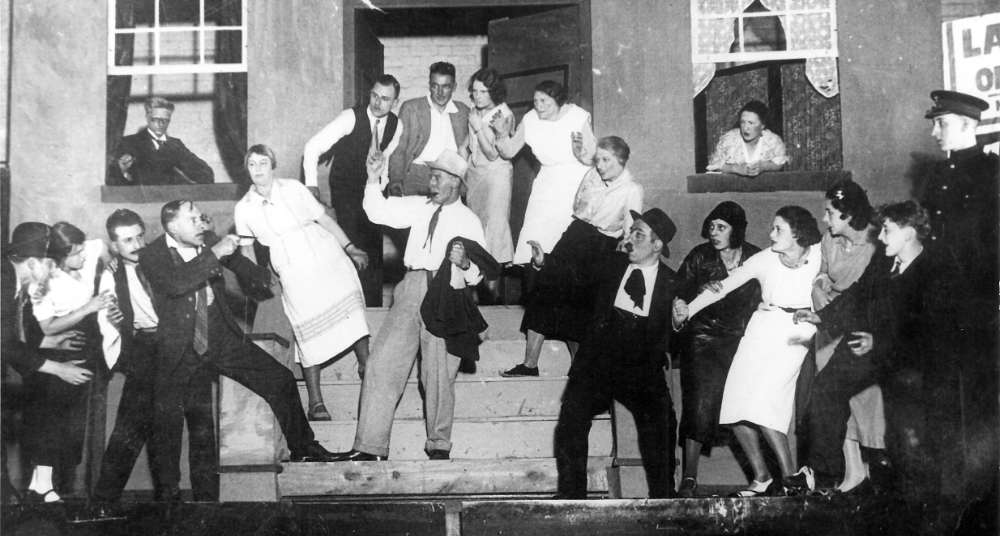
A scene from our very first production, Street Scene, in 1932
Explore all our productions since 1932
BEGINNINGS
Masque Theatre began with a different name. The Northampton Town And County Drama League was formed on Tuesday, 10 October, 1931.
Amateurs from some eight or nine local groups decided to co-ordinate their activities and further interest in drama locally.
Affiliated Societies paid five shillings per annum, members of societies two shillings and members of the general public, two shillings and sixpence.
In 1992, Joyce Sampson (née Belville) recalled that first meeting. Writing in the Northampton Chronicle & Echo, she said: "Only a very few will remember the inauguration of the Northampton Drama League. I was a founder member - just 17 years old - who as a drama student of the Young Women's Christian Association (the centre of our young lives in those days!) represented that association when the Drama League project was first mooted. Many young actors and actresses just starting their careers trod those boards, and many became household names."
It was just under a year later when the League produced their first play. On 26 and 27 October 1932, Street Scene, by the American playwright Elmer Rice, was performed at St Michael's Church Hall on St Michael's Mount, Northampton.
The play follows the lives of people living in a New York neighbourhood and it had recently been turned into a Hollywood movie.1932
Northampton Town & County Drama League stages its first production
Oswald Mosley forms the British Group of Fascists
King George V becomes the first British monarch to broadcast a Christmas Day message
1933
Adolf Hitler is elected Chancellor of Germany
1934
The Drama League performs its first open air production
1936
The death of King George V. Edward VIII ascends to the throne but abdicates 11 months later. George VI becomes King.
Civil War begins in Spain
The Jarrow March to highlight mass unemployment and poverty
The world's first high definition television service is started by the BBC
1937
Neville Chamberlain becomes UK Prime Minister
The Drama League becomes the Northampton Drama Club
1939
Germany invades Poland. Britain declares war on Germany.
OPEN AIR
1934 saw the League’s first open-air performance.
A Midsummer Night’s Dream was staged in the grounds of Manfield Hospital on Kettering Road.
Another open-air production, Lady Precious Stream by the Chinese writer Hsiung Shih-I, followed in 1935. The League became the first amateur group in the country to stage the play, which had recently opened in the West End. The group performed it twice more before the decade was out.
Jonah and the Whale by James Bridie was presented at the Royal Theatre (then best known as the Northampton Rep) for a single matinee performance in 1936.
At that time, scenery and props were stored in premises in Swan Yard, not far from the present-day St John’s multi-storey car park. These were moved to the Rep on a handcart following the professional company’s Friday evening performance. The Jonah set was put up and after the show was immediately struck in time for the Rep to do their two performances in the evening.
In 1937 the League was renamed the Northampton Drama Club and productions were staged at St Crispin’s Hall on Earl Street, Northampton.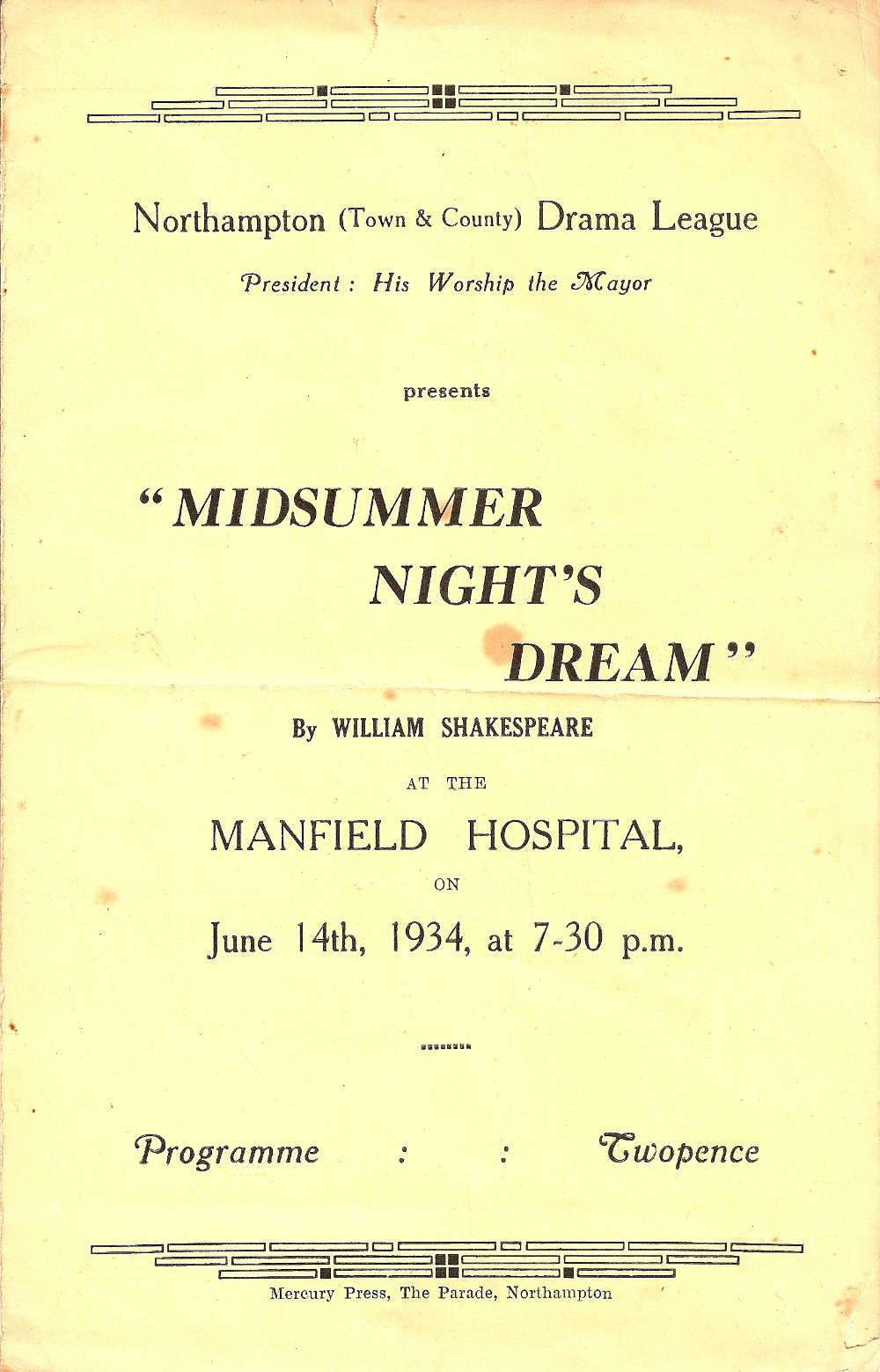
Programme for Midsummer Night's Dream in 1934
WAR TIME
For most of the Second World War, the Northampton Drama Club managed to stage plays.
As a consequence of war, fuel supplies were scarce and non-essential travel was discouraged. An official attempt to persuade civilians to conserve fuel was the ‘Holidays at Home’ campaign during 1942-3. Local authorities drew up a programme of summertime events. In Northampton the Borough Council engaged the help of the Northampton Drama Club.
During the summer of 1942, the Drama Club presented Twelfth Night. It was directed by Tom Osborne Robinson and Lawrence Baskcomb, who were respectively a set designer and an actor at the Rep. Appearing in the play was Richard Baker who had been evacuated to Northampton. He later went on to become the first BBC TV newsreader.
Years later, Masque member Alison Dunmore recalled that during the war years fabric was rationed, causing challenges for those making the costumes: “only felt, net and lace were available without coupons. Using felt, a brilliantly coloured but unwieldy fabric, Tom [Osborne Robinson] evolved a style that used the distinctive outline of Elizabethan costumes and enhanced it with bold appliquéd design that suggested the ornament of that time. ‘Shakespeare costumed all his plays in contemporary dress,’ said Tom, ‘and so should the Drama Club.’”
During the war, the summer shows were presented outdoors in local parks. The Importance of Being Earnest (1943) and A Midsummer Night’s Dream (1945) were performed beside Abington Park lake. Toad of Toad Hall (1944) was staged near Delapre Abbey.1940
Winston Churchill becomes UK Prime Minister.
The Battle of Dunkirk.
The Battle of Britain.
1941
The Blitz.
The German Enigma Code is cracked by Alan Turing and his team.
1942
'Holidays at Home' begins with the Drama Club staging Twelfth Night.
The Beveridge Report proposes the start of a Welfare State in the UK.
1945
US drops atomic bombs on Japan.
Second World War ends.
Clement Attlee becomes Prime Minister with a landslide victory.

The 1942 production of Twelfth Night. Richard Baker, who went on to become BBC TV's first newsreader, is on the far left.
DEMOB HAPPY
When the war ended plans could at last be made for the future.
“There was an energetic infusion of recently demobbed young talent,” recalled Alison Dunmore. “Notably Geoffrey Brightman who soon turned professional and two young journalists from the local paper: Jack Alcock and Michael Green. Mike was to draw on his experience at that time when writing his Art of Coarse Acting. Also from the literary world was writer and broadcaster Eric Roberts who wrote for the Chronicle & Echo”.
In 1946, the courtyard of Abington Park Museum was the venue for Much Ado About Nothing, a space that became home to the summer shows for many years.
In 1947, after several temporary homes, a "dirty warehouse" in Thenford Street was rented. After pigeon evictions, structural alteration, painting and cleaning, Northampton Drama Cub finally had its own little theatre, although it was initially used as a club house and for studio performances.
Amongst the members rolling up their sleeves was Sybil Williams. She’d taken the lead role in Goodness How Sad (1947) and was trying hard to break into the acting profession. She went on to become the first wife of the celebrated stage and film actor Richard Burton and, decades later, is said to have opened the first disco in the United States.
Michael Green recalled a memorable production in 1948 featuring another member: “My first part was in The Merchant of Venice in Abington Park when I was a young reporter on the Chronicle and Echo. What I remember most (apart from a wonderful performance of Shylock by John Parkin) was the man playing Launcelot Gobbo who during the play would pull his trousers over his tights and sprint across the park to a pub for a couple of pints before hastening back for the final scene which can only be described as unusually vigorous!”.1946
The courtyard of Abington Park Museum is used for the Drama Club's open air Summer Show for the first time.

Much Ado About Nothing at Abington Park Museum (1946).
1947
India gains independence from Britain.
The inaugural Edinburgh International Festival is held.
The Drama Club rents a disused warehouse on Thenford Street in Northampton and work starts on turning it into a theatre.
1948
Immigrants start to arrive from India and Pakistan. The Windrush Generation begin to arrive from the Caribbean.
The Republic of Ireland is established.
The National Health Service is founded.
The Olympic Games are held in London.
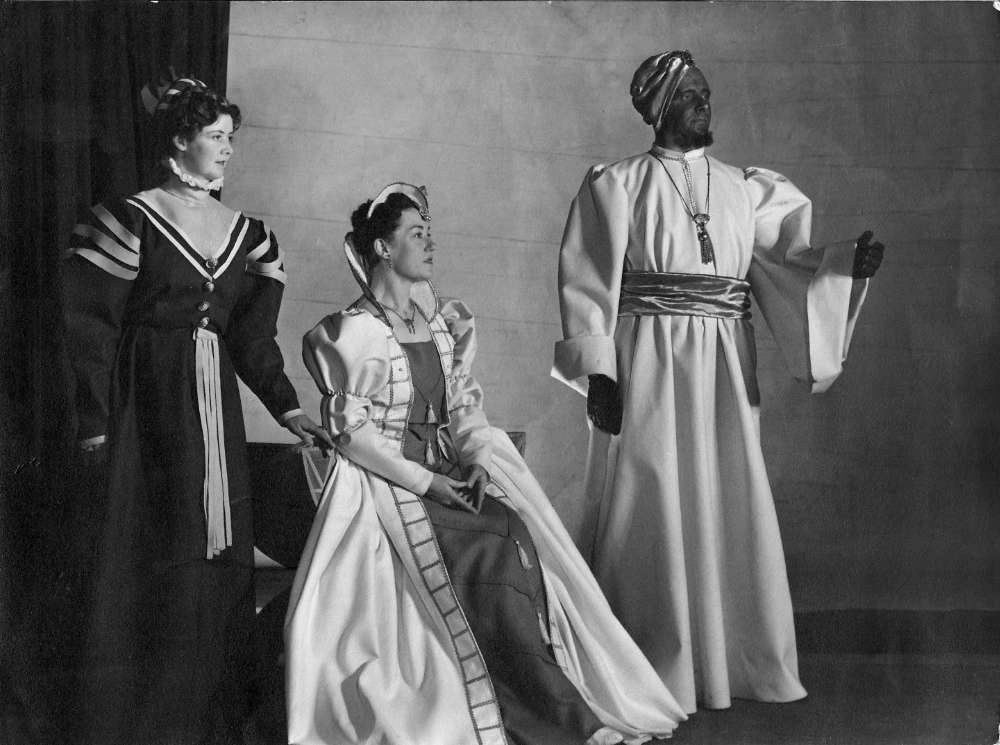
The Merchant of Venice (1948).
THENFORD STREET
The Northampton Drama Club’s new performance space on Thenford Street was named the Masque Theatre (pictured on the right is the theatre's foyer). It was the first private theatre club in the East Midlands.
The first production, opening in March 1951, was Oscar Wilde’s The Importance of Being Earnest.
The theatre was largely the brainchild of Aubrey Dyas Perkins, a local solicitor, who chaired the Drama Club for 14 years. He later became chair of the Northampton Repertory Players.
A reporter for The Times, who came to see Cardenio in 1955, described the Masque Theatre as “an intimate and comfortable little playhouse and club,” He also mentioned the “strip of fore-stage, curtained proscenium doors which slide in and out, neat scenery on revolving panels,” and the “diagonal traverses for a triangular interior and excellent lighting.”
Bryan Hall, who joined the group in the early 1950s, described the Masque Theatre as “a complete and utter death trap.” He explained: “It was situated over a paint shop. One went up a little narrow staircase to what can only be described as a passage where you bought your tickets. You then went into the foyer (see photo above). From there you went up some more stairs to the theatre itself which was very, very small.
“There was really only one entrance onto the stage and that was up a tight staircase from the side of the foyer. At the back of the stage was a small room; if you made your exit into there you were stuck until there was a blackout or the curtain came down.
“I’d hate to think what would have happened if there was a fire because the fire exit meant clambering out of a window and across the roofs; we’d never get away with it these days.”1951
First performance at the new Masque Theatre on Thenford Street
The Festival of Britain is held.
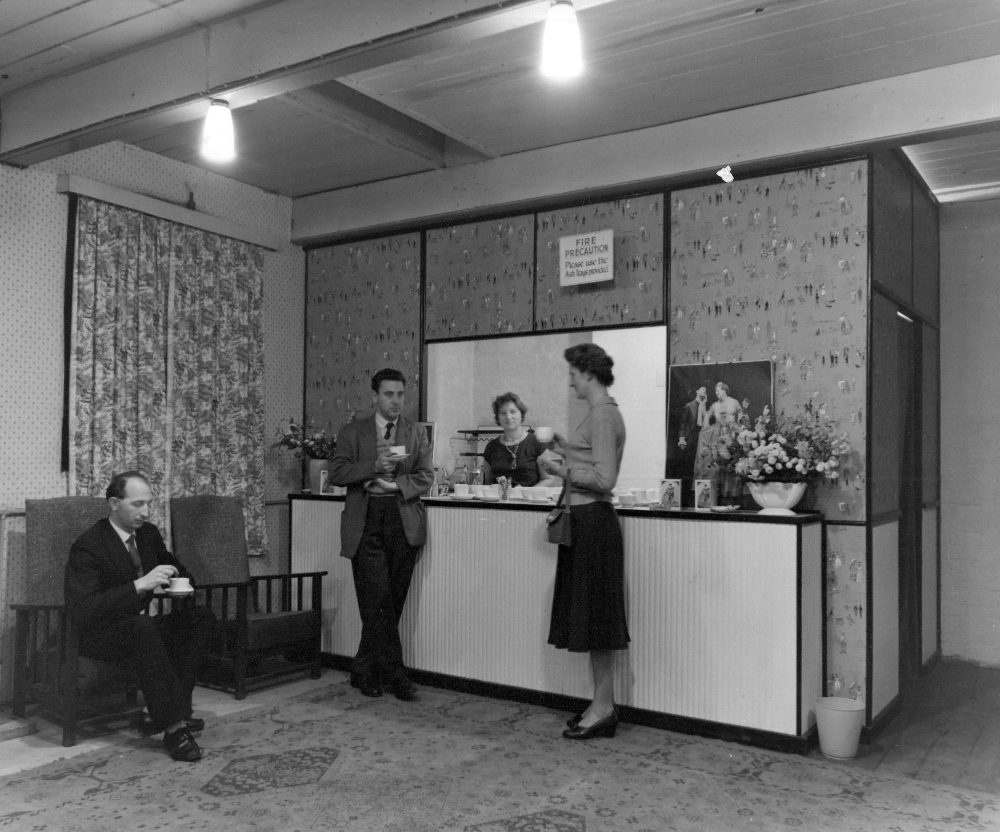
The foyer of the Masque Theatre on Thenford Street.
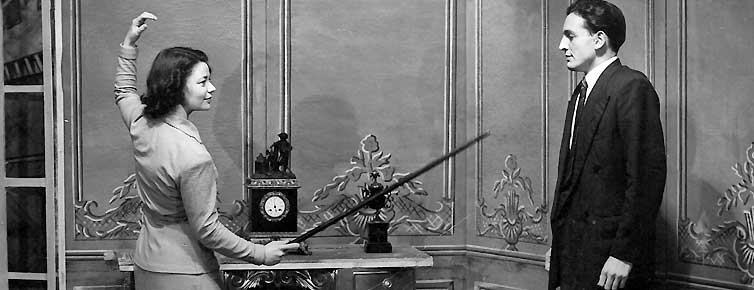
The Typewriter by Jean Cocteau (1951)
1952
Queen Elizabeth II ascends to the throne.
The Mousetrap begins its world beating run in London's West End
The Great Smog of London
1958
The New Theatre in Abington Street, which opened in 1912, stages its last performance. It's demolished in 1960.
CLASSES AND TECHNIQUE
Jean McNamara joined the Northampton Drama Club in 1947.
She said the Thenford Street theatre was valuable for many reasons: “Not only did we do our major productions there and rehearse there, but we had Sunday night meetings for members. We put on One Act plays; we had our own mini-Shakespeare festival with adjudicators and youngsters could learn to act and direct without a paying audience.
“Joan Fisher gave classes on voice production and Mary Honer gave evening classes on stage movement. It was about learning technique.”
Mary Honer was one of the notable members of the group during the 1950s. She had been a ballerina with the Vic-Wells Ballet (later the Royal Ballet) during the war. In 1952, she directed Lady Precious Stream.
Sir Gyles Isham was the 12th Baronet living at Lamport Hall. He was also an actor, appearing during the 1930s at the Old Vic with Donald Wolfit, John Gielgud and Sybil Thorndyke amongst others. Sir Gyles directed Twelfth Night for the Northampton Drama Club in 1951. He was president of the group from 1953-58.1953
Northampton-born Francis Crick and James Watson from the US discover the structure of DNA.
Coronation of Elizabeth II.
Ian Fleming publishes Casino Royale, the first James Bond novel.

Goodnight Children by J.B. Priestley (1953)
1954
End of food rationing.
NATIONAL RECOGNITION
One notable achievement of the Northampton Drama Club was the presentation in 1955 of Cardenio, attributed to John Fletcher and William Shakespeare.
This was the first known performance of this play since 1613 and it attracted favourable notices in the national press.
A routine was established: four productions would be performed in the Masque Theatre, and a play in the open air in the courtyard of Abington Park each Summer.
Barry Hillman joined the group during the decade, attracted, he said, by the number of contemporary plays performed by the group: “I liked their aspirations in those days. They were very much for ‘art for art sake’".1955
ITV starts broadcasting.
The Drama Club stages Cardenio, said to be the first time since 1613.
1956
The UK's first nuclear power station is switched on.
The Suez Crisis.
1958
Britain's first motorway opens.
1959
The M1 motorway opens.

This 1955 production of Cardenio was said to be the first known performance since 1613.
MASQUE THEATRE
In 1964, after 27 years, the Northampton Drama Club was renamed Masque Theatre.
It was felt that there was some confusion between the names of the Club and the Masque Theatre on Thenford Street where the Club performed.
A year earlier, the group had become a member of the Little Theatre Guild of Great Britain and was host to the Guild for its production of Dandy Dick by Pinero.
The group was becoming well established on Thenford Street. Most productions were performed there and, according to the accounts, audiences ranged from 60% to 97% capacity.
The open-air summer shows used the courtyard of Abington Park Museum. A Chronicle & Echo review of the 1960 Summer show pointed out that: “Romeo and Juliet's tender exchanges may be punctuated by the raucous cries of peacocks”.
Writing in 2000, Greta and John Hendy recalled an incident during the 1968 production of The Winter’s Tale in the courtyard: “One of the courtiers, carrying off the body of Hermoine, went through the stage (mostly made out of beer crates) up to his thigh, sustaining nasty grazes and almost tipping the ‘body’ out of her chair.”
Most of the open-air shows were popular Shakespeare plays but, as in previous decades, Masque would occasionally try something a little different. In 1962, the choice of Summer show was The Hypocrite by Isaac Bickerstaffe and in 1965, it was George Farquhar’s The Recruiting Officer.
The decisions were not always popular. A review of The Hypocrite in the Chronicle & Echo praises the production but adds: “While “The Hypocrite” - with its stylised dialogue, elegant costumes and almost Moliere-like predictability of plot is a good choice for an outdoor production, it seems unlikely that it will prove such an attraction to the Northampton public as a Shakespearean production - their usual choice - might have done.”
Masque Theatre’s present-day patron, Lesley Joseph, made her first appearance with Masque in 1964, appearing in The Firstborn by Christopher Fry. She went on to play Hermia in Masque’s open-air production of A Midsummer Night’s Dream in the courtyard.1960
Harold Pinter's The Caretaker is first performed.
John, Paul, George… and Stuart Sutcliffe form The Beatles.
1961
The Soviet Union's Yuri Gagarin becomes the first person in space.
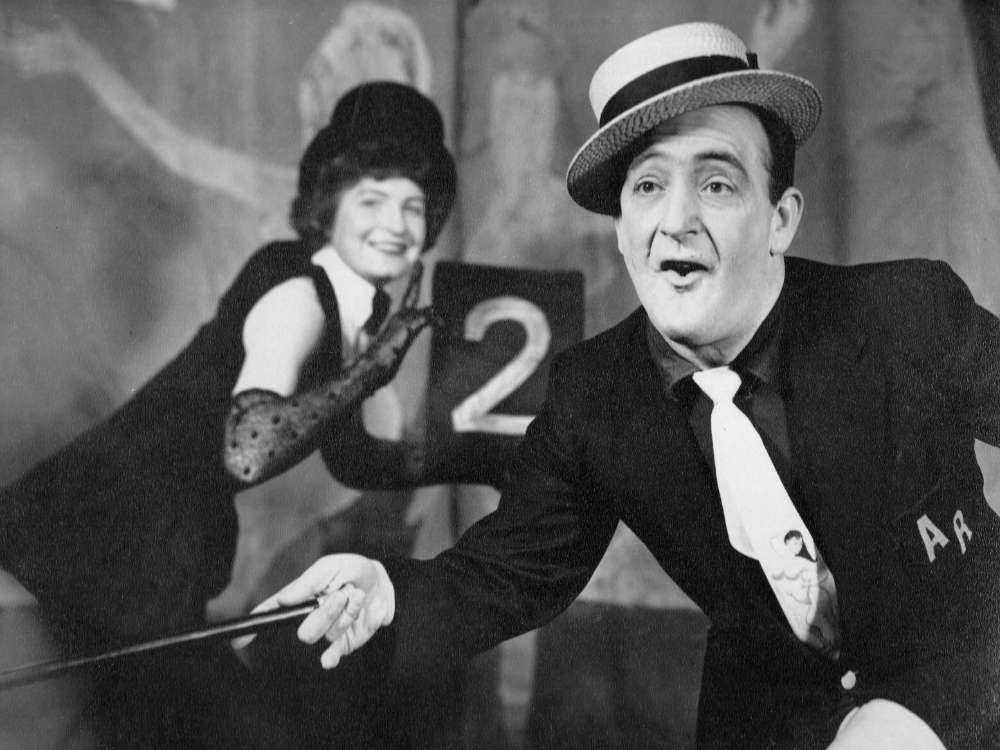
The Entertainer by John Osborne (1961)
1963
US President John F Kennedy is assassinated.
The first episode of Doctor Who is broadcast.
The National Theatre is established.
1964
BBC 2 starts broadcasting.
Northampton Drama Club changes its name to Masque Theatre
1965
Comprehensive schools are introduced.
The death penalty is abolished.
1966
England wins the World Cup.
1967
Partial decriminalisation of homosexuality and abortion.
1968
The Lord Chamberlain no longer has to censor plays staged in theatres.
1969
Neil Armstrong becomes the first person to walk on the moon.
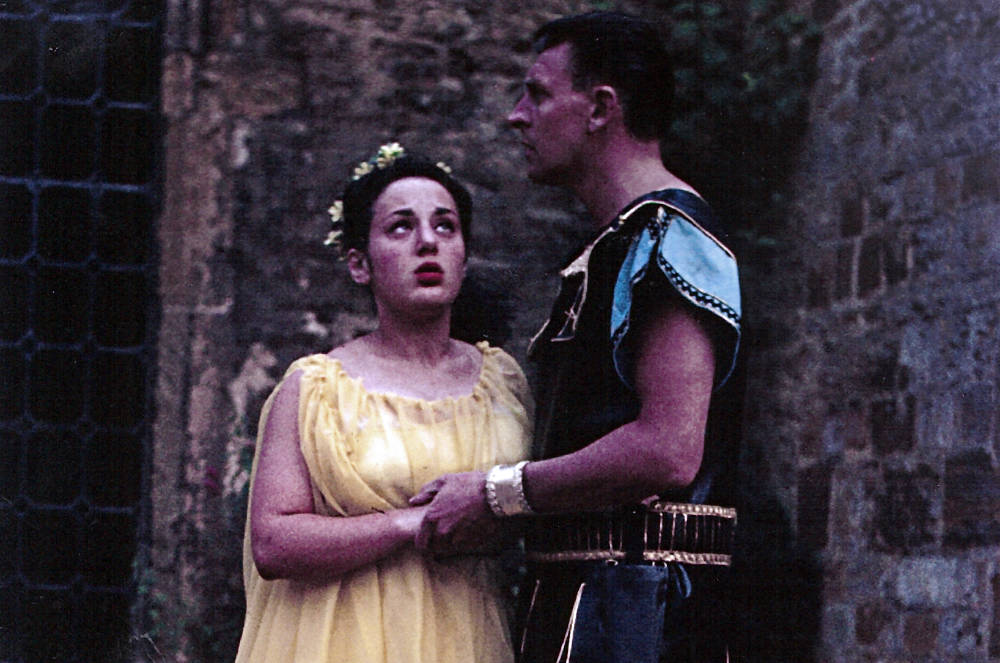
Lesley Joseph as Hermia and Bryan Hall as Lysander in the 1964 production of A Midsummer Night's Dream
FAREWELL TO THENFORD STREET
The landlord of the Thenford Street premises, who ran an invalid carriage repair business on the ground floor, decided that he needed the whole building. Masque Theatre was given notice to quit.
The last performance was, appropriately enough, All Over by Edward Albee, in 1974.
But where should Masque perform now? After some panic, a temporary solution was found when Jessie Knight of the Arts Theatre Club offered use of their premises in nearby Pytchley Street. The theatre was a similar size to the old one on Thenford Street.
Henry Telfer Ltd of Moulton Park offered the use of their staff coffee lounge for rehearsals and Masque rented a house in Military Road for storage and the wardrobe. Unfortunately, the house proved to be damp and, for some years, the costumes were dispersed and stored in members’ houses.
During the 1970s, a youth theatre was run by Joan Fisher with some youth theatre productions directed by Dennis Phillips.
In 1979, The School For Wives by Moliere, directed by Margaret Dickens, was put on at the Spinney Hill Hall and subsequently toured in the United States.
The last production at the Arts Theatre Club was in 1979 after which productions were performed in Northampton College’s studio theatre on Booth Lane, with occasional excursions to the Lings Theatre.1971
Decimal currency is introduced.
The first email is sent.
1972
Bloody Sunday in Northern Ireland.
1973
The UK joins the European Economic Community.
Industrial action by coal miners and railway workers leads to the three day week.
The first mobile phone call is made.
1974
Masque Theatre moves out of its theatre on Thenford Street. Future productions are staged at the Arts Theatre Club on Pytchley Street.
1976
The National Theatre building in London opens.
1978
The first 'test tube baby' is born.
1979
Masque's production of The School For Wives tours the United States.
Margaret Thatcher becomes the first female Prime Minister.
Masque's last production is staged at the Arts Theatre Club on Pytchley Street. The group's main performance space moves to Northampton College's studio theatre on Booth Lane.
Explore all our productions since 1932
REPUTATION FOR QUALITY
During the 1980s, Masque Theatre continued to gain a reputation for its quality productions.
Writing for the Chronicle & Echo in 1980, the paper’s theatre reviewer John Gilbert wrote: “The fortunes of amateur drama groups wax and wane and this production is further evidence, that the Masque are once again in the ascendant.”
On the right is Les Necus and Bryan Hall in the 1980 production of Harold Pinter's The Caretaker.
The good reviews went through to the end of the decade when the Herald & Post’s review of Alphabetical Order by Michael Frayn said: “Masque Theatre showed last week why they are one of the best am dram companies in Northampton.”
During the decade, the open air plays were always by Shakespeare and were usually comedies. But directors liked to experiment. Alison Dunmore recalls one particular summer show: “In the 1981 production of The Tempest, Prospero’s island was inhabited by performers costumed as from a Japanese Noh play complete with mask-like oriental make-up.”
Another memorable production - perhaps for all the wrong reasons - was The Marriage of Figaro (1985). The Greta and John Hendy recalled: “An actor cut out an essential scene causing total panic among the actors and crew and puzzling the audience (those that actually noticed something was wrong!) ‘How did Cherabino get out of that locked room?’”
It was apt that in 1983 when Masque celebrated its 50th birthday, Michael Green’s The Coarse Acting Show was the chosen production.
One notable achievement was in 1985 when Jean McNamara’s production of The Inhabitants by Olwyn Wymark reached the All-England final of the British Drama League’s One Act Play Festival.
In 1986, Mark Stephens did two productions with Masque: Kes and Two Gentlemen of Verona. Today he is better known as Marc Warren (Danny Blue in Hustle, Dougie Raymond in The Vice, Dominic Foy in State of Play and Rick in Mad Dogs). He thanks Masque Theatre for helping he get his first professional break: “Somebody saw Kes and gave me my break at the Northampton Royal Theatre, which was my professional debut. So thank you very much for that.”1980
Ronald Reagan becomes US president.
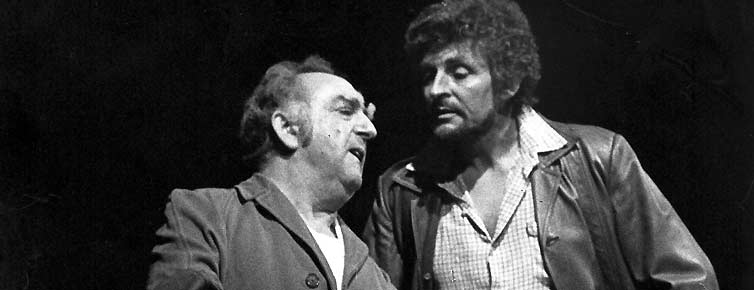
The Caretaker by Harold Pinter (1980)
1981
The wedding of Prince Charles and Lady Diana Spencer.
The IBM personal computer is launched.
1982
The Falklands War.
The first CD is issued.
Channel 4 starts broadcasting.
1983
The Derngate opens alongside the old Royal Theatre.
Masque Theatre stages The Coarse Acting Show to celebrate its 50th birthday.
Channel 4 starts broadcasting.
1984
The Miners' Strike.
The first Apple Macintosh computer is launched.
1985
Live Aid.
Mikhail Gorbachev becomes leader of the Soviet Union.
Les Miserables opens.
1986
Phantom of the Opera opens.,
1988
The Lockerbie Bomb - Pan Am flight 103 is blown up over the Scottish town.
1989
Invention of the World Wide Web by Tim Berners Lee.
Tiananmen Square protests in Beijing.
The fall of the Berlin Wall.
SUMMER SHOW CHANGES
The start of the 1990s saw a change to one of Masque Theatre’s annual events.
The open-air summer show, which had been performed every year since 1946 in the courtyard of Abington Park Museum, was forced to move.
The former manor house, which houses the museum, was built at the turn of the 16th Century and was once home to Shakespeare's granddaughter. By 1990, the deteriorating condition of the building meant that essential repairs were required. Masque had to find a new venue for the summer shows.
After one year at the Park Campus of Nene College (now the University of Northampton), Masque was offered the use of the lawns of the School of Occupational Therapy at St Andrew’s Hospital on Billing Road.
The screech of peacocks, which used to punctuate performances at the museum, now gave way to upstaging by rabbits and the grunts of hedgehogs.
The move from the museum also saw another change: the end of the official sponsorship of the summer shows by Northampton Borough Council. The Northampton Corporation had first promoted the show in 1942 as part of the Holidays at Home campaign during the Second World War. The 50th anniversary was commemorated in 1992 with Twelfth Night.
The summer shows, which by now were always plays by Shakespeare, would continue to be imaginatively set. 1990‘s As You Like It, director John Cartwright had Rosalind and Celia dressed for skiing. The 1996 version of A Midsummer Night’s Dream had a Hollywood theme. The director, Barry Hillman, explained in the programme notes: “The fantasy fairy world is now the U.S.A. fantasy of the silver screen - with Norma Desmond its queen: the spiritual emanates from the indigenous Indian native; the rulers are Gone with the Wind landowners and the military; the rustics are hill-billies, and the lovers are ranchers.”1990
Poll Tax riots and Margaret Thatcher resigns as Prime Minister.
Reunification of Germany.
Masque's open air Summer Show moves to the grounds of St Andrew's Hospital.
Satellite TV arrives in the UK.
1991
First Gulf War.
1992
Bosnian War.
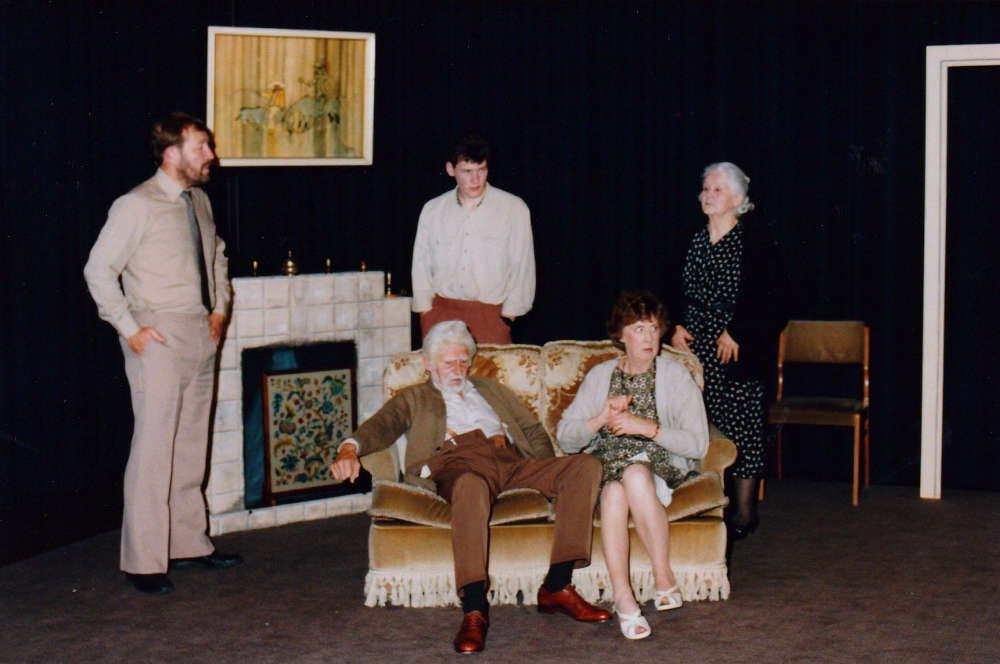
Happy Families by John Godber (1991). Masque was one of 50 community theatre companies across the country to stage this new play during October. It was promoted as the biggest world premier in theatrical history.
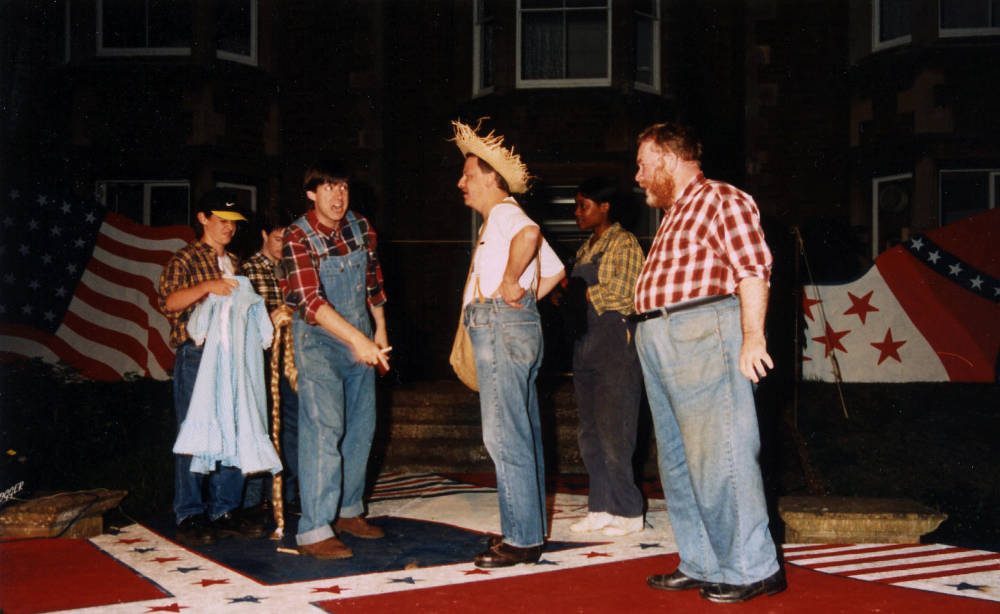
A Midsummer Night's Dream in 1996 had an American theme
OOPS
A memorable incident during a live performance happened during the run of Our Country’s Good in 1994.
The play, by Timberlake Wertenbaker is set in a 1780s Australian penal colony. Greta and John Hendy wrote about it in their history of Masque: “an actor went on with a wire coat-hanger suspended from the pocket of his military frock coat. Everyone else noticed and were corpsing left and right and centre but he remained oblivious.”
Then there was the sound man in the same production who, according to the Hendys: “surrounded by miles of loose tape, said triumphantly ‘I’ve found the gunshot’ five minutes after it was needed.”1994
The Channel Tunnel is officially opened.
1996
Shakespeare's Globe opens in London.
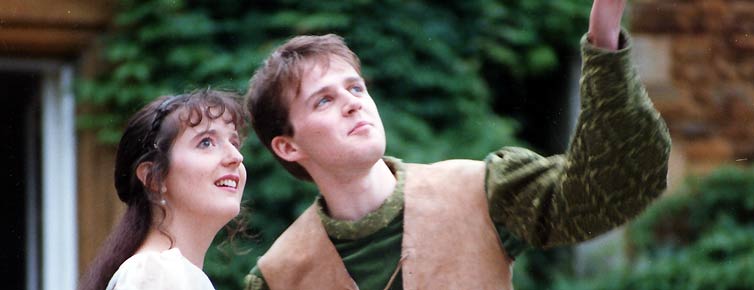
Romeo & Juliet (1994). Adam Young's Romeo so impressed the artistic director of Northampton's Royal Theatre that he was given some professional engagements.
ALAN CARR
Each season, four indoor productions were staged, nearly all at Northampton College’s studio theatre off Booth Lane.
In 1998, a 22-year-old man took the part of Charles Surface in Sheridan’s The School For Scandal. Alan Carr, of course, went on to become one of the nation’s most popular comedians.
Director Ursula Wright recalls: “Alan was wonderful to work with. Although not entirely suited to the role, he brought a professional attitude and self-deprecating charm to all rehearsals.” One scene was “performed with the dry wit and accurate timing which characterise his stand-up routines today.” Ursula adds: “He was a talented young actor, somewhat camp in manner.”
Alison Dunmore also has vivid memories of Alan Carr during that production, especially his underpants: "He had see-through, light-fitting britches but the only garments he produced to wear underneath were gory, youthfully exuberant boxer shorts."
When told that he’d need to wear something more suitable and less visible, he professed not to own anything. "His solution was to wear nothing underneath," recalls Alison with a chuckle. "The britches were not firm in texture, leaving little to the imagination, and we had a rather interesting rehearsal!"
Emma Austin attended the same Lower, Middle and Upper Schools at Alan. She writes: "we both lived in the Abington area and we'd chat outside the Co-op on Barry Road. "OH 'ELLO!" - he'd shriek when he saw me. I recall watching him in The School for Scandal and saying at the time that you could not take your eyes off him. He had such presence and he knew how to use that extraordinary voice of his and he was trouser wettingly funny; I have to admit he was a scene stealer and he knew it!"1997
Tony Blair becomes Prime Minister.
The Scottish Parliament and Welsh Assembly are established.
The first Harry Potter book is published.
Princess Diana and Dodi Al Fayad are killed in a car crash in Paris.
Global Warming as a result of Climate Change is a growing concern, leading to the Kyoto Protocol for countries to reduce carbon emissions.
Masque Youth Theatre is re-formed.
1998
The Northern Ireland Agreement brings long-term peace.
The Easter Floods hit St James and Far Cotton in Northampton.
1999
The euro is introduced by an initial 11 EU countries.
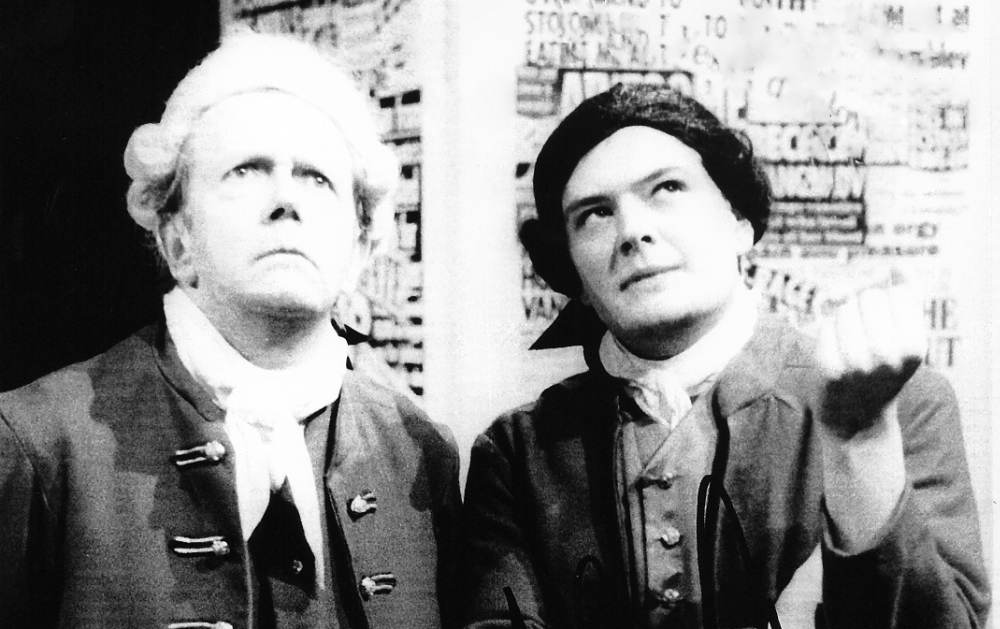
David Ashton and Alan Carr in The School For Scandal (1998)
YOUTH THEATRE
As the 1990s drew to a close, Ursula Wright re-established a Masque Youth Theatre. Formed in November 1997, MYT’s first production was Knock, Knock in 1998. Scores of young people took part with with MYT for more than 20 years.
In the first decade of the new century, Masque Theatre was able to return to the courtyard of Abington Park Museum to stage its annual open-air Shakespeare plays.
Other venues were brought into use. The ancient Church of the Holy Sepulchre on Sheep Street is a round church built at the time of the Crusades and is an ideal space for theatre-in-the-round. In 2008, following the redevelopment of Northampton College on Booth Lane, Masque started to regularly use The Playhouse on Clare Street. The first performance there was Trainspotting.
At the start of 2008, Masque Theatre gets online with a website promoting future productions and an archive of previous shows.
Also in 2008, the long tradition of choosing only Shakespeare plays for the Summer open-air production was broken. The Venetian Twins by Carlo Goldoni was the choice of director Bob Godfrey. The previous non-Shakespeare Summer Show was The Recruiting Officer in 1965. In 2010, The Comedy of Errors was performed for one week followed by The Wind In The Willows for a week. The experiment was tried again in 2012 with The Tempest and Arabian Nights.2000
Masque Youth Theatre performs Zero Zero, a specially-commissioned piece to mark the new millennium.
2001
Masque's open air Summer Show returns to the courtyard of Abington Park Museum.
9/11 terrorist attacks in the USA.
2003
The second Gulf War.
2004
Facebook is launched.
2005
Civil Partnerships are introduced for same-sex couples giving them legal rights for the first time.
2006
Twitter is launched.
2007
The Apple iPhone is launched.
BBC iPlayer launches on Christmas Day.
2008
Masque Theatre's website is launched.
Masque Theatre breaks a tradition which had lasted for 43 years by not performing a Shakespeare play as their open air Summer Show.
The Global Financial Crisis
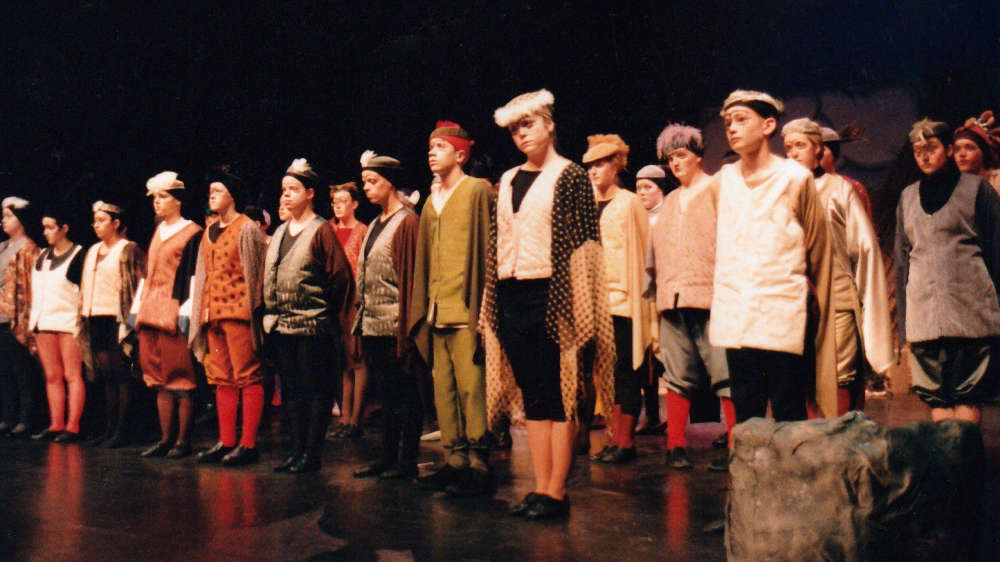
The Birds by Aristophanes performed by Masque Youth Theatre (2003)
BURNS STREET
2012 marked the eightieth anniversary of the group's first production, so a special gala night was held at the Royal Theatre. Four Score and Then was devised and directed by Ursula Wright and featured extracts from eight shows from the company's history including the very first show, Street Scene.
Masque Theatre has always been looking for a permanent base. A dedicated theatre has long been a dream but money is always an issue. There is also an advantage of being able to hire a venue which is suitable for a particular play, rather than having to stage every production in the same space.
In 2013, the Burns Street Studios became the meeting and rehearsal space for Masque Theatre. For the first time since 1974, the group had somewhere to call home.
In 2011, the Mayor of Northampton presented the group with a Heart of the Community Award to highlight the importance the group has to the town.
In 2014, Masque performed Becket by Jean Anouilh in Northampton's Guildhall. It marked the 850th anniversary of Archbishop Thomas Becket's trial at Northampton Castle.
Another anniversary was the 400 years since William Shakespeare's death. In 2016, Masque performed Shakespeare's Songs and Sonnets in the Great Hall at Abington Park Museum, where Shakespeare's granddaughter once lived.
New directors and production crew were encouraged in 2017 with a festival of one act plays called New Directions.
And in 2019, new writers were encouraged with Twisted Tales. Three brand new short plays were developed and performed.2011
Masque Theatre is awarded a Heart of the Community Award.
2012
Masque's 80th birthday is celebrated with a gala performance at the Royal Theatre.
The London Olympics.
Netflix launches its streaming service in the UK.
2013
The Burns Street Studios becomes Masque Theatre's new home for meetings and rehearsals.
2014
In a referendum, Scotland decides to remain in the UK.
2016
In a referendum, 52% of people vote for the UK to leave the European Union.
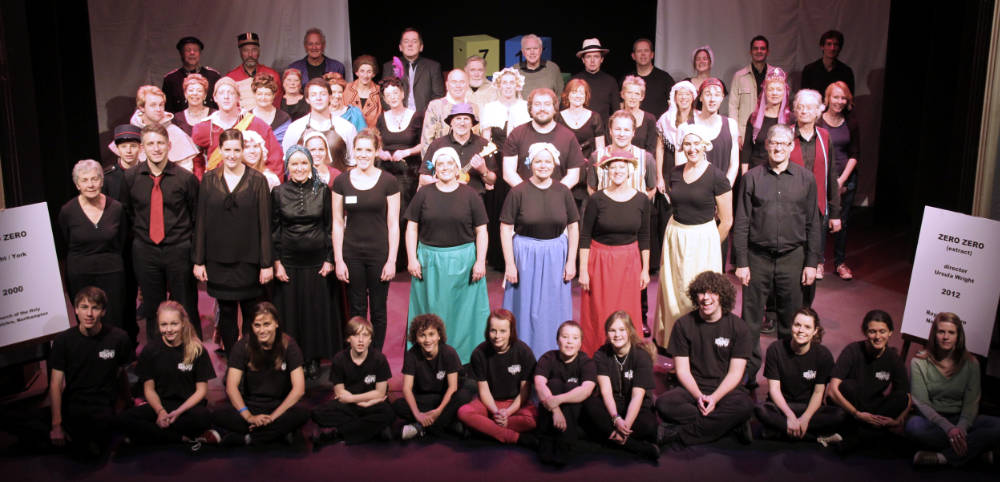
Curtain call at the Royal & Derngate as Masque celebrates its 80th birthday
PANDEMIC
Masque's 2020 season is put on hold as coronavirus spreads around the world. In March, theatres are shut as part of a national lockdown.
The group experiments by staging a rehearsed reading of Romeo & Juliet by video link.
It's 71 years since the group last missed a year of productions; that was in 1941 during the early years of the Second World War.
The Taming of the Shrew in July 2021 is the next show. As an open air production it is safer, and easier to keep the audience socially distanced.
For Masque Theatre's 90th anniversary year, new writers were encouraged to write a short play. Two plays were performed at an evening called It's About Time. And an exhibition of photos and costumes charting the group's 90 years was held at Abington Park Museum.
Masque Theatre continues to stage an eclectic mix of plays, comedies (and even an occasional musical) at various venues in Northampton.
We welcome new members. Come and join us.
Find out more about our latest productions.
And take a look back through our long history and explore all of our previous shows.2020
The UK formally withdraws from the EU beginning an 11-month transition period.
The Covid-19 pandemic.
Theatres across the UK are shut as part of a national lockdown.
2021
Masque returns to live theatre with The Taming of the Shrew, postponed from 2020.
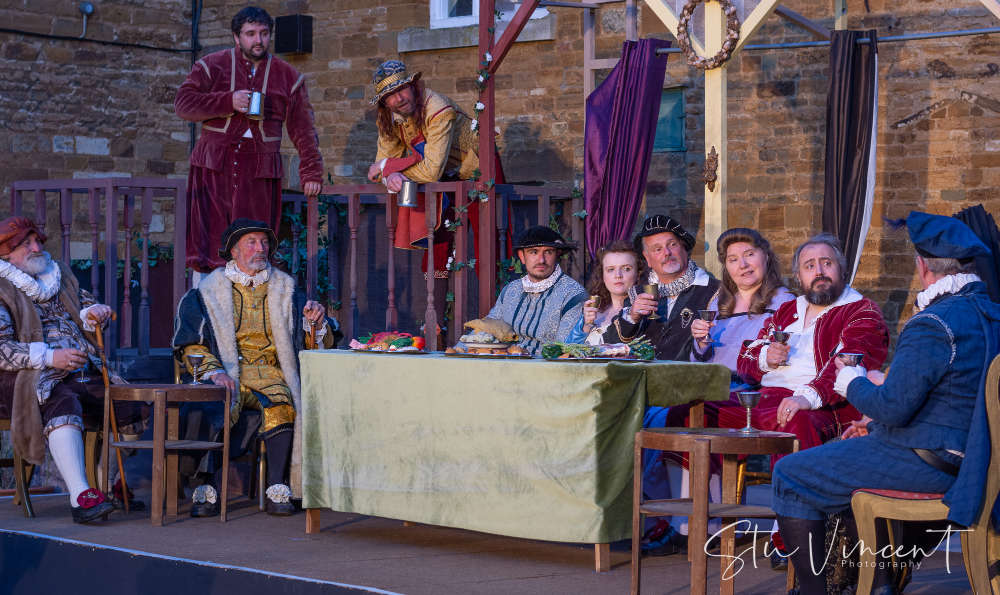
The Taming of the Shrew (2021).
2022
Masque Theatre celebrates its 90th birthday.
This information is adapted from the history researched and written by John and Greta Hendy with Alison Dunmore; edited and conceived by Rob Kendall and published in 2000. New material has been compiled and written by Martin Borley-Cox.
Explore all our productions since 1932